
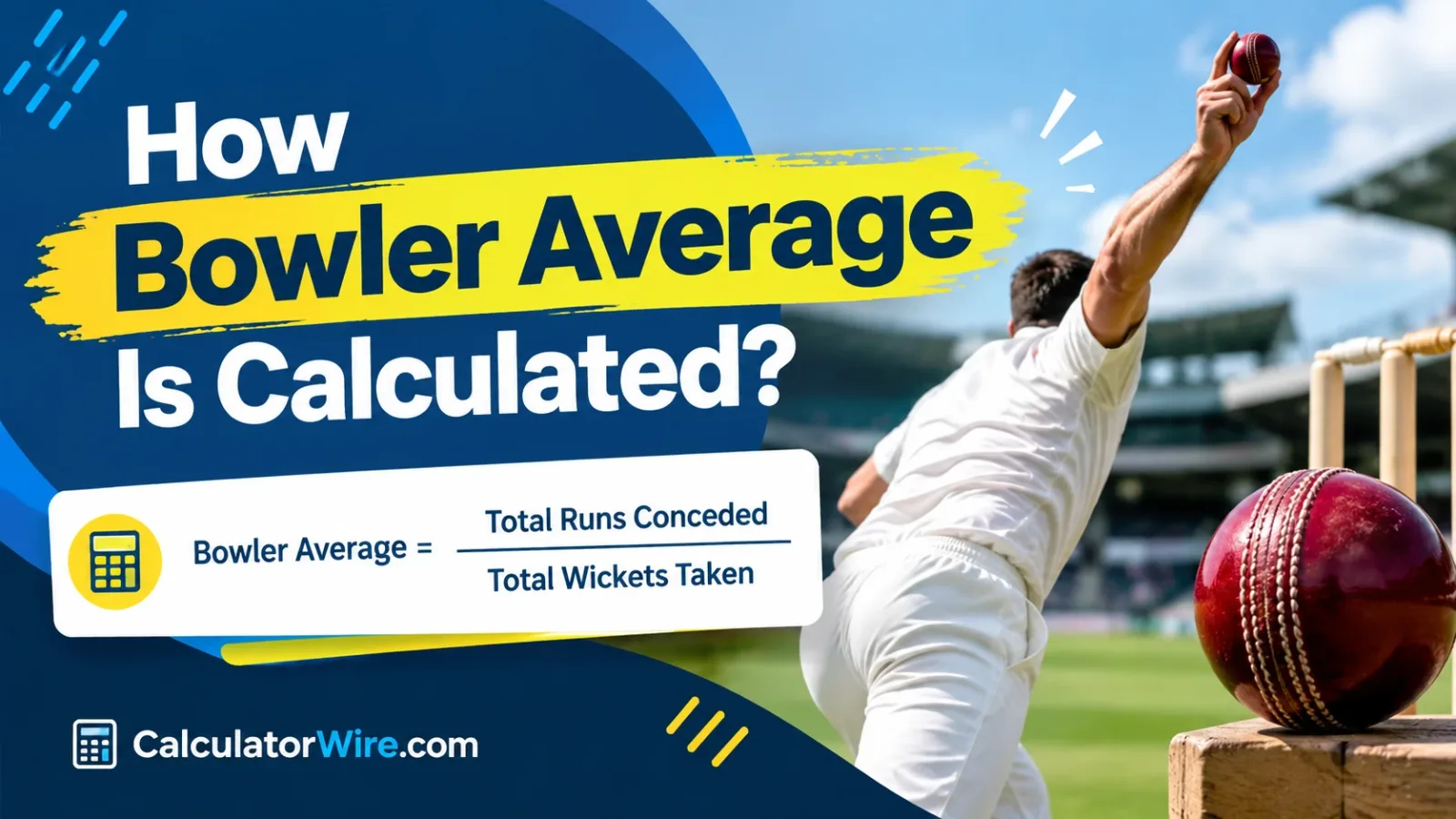
Ask a cricket fan who the best bowler of all time is and you will get a dozen different opinions. Ask them to make their case based on statistics, and you’ll hear the same answer almost always. This is the bowling average, a measure of the most basic of all bowling values — the cost of dismissing a batter.
The Formula for the Bowling Average
The bowling average is calculated as follows:
Bowling Average = Runs Conceded ÷ Wickets Taken
The answer is measured in runs per wicket. If a bowler conceded 2,400 runs and took 100 wickets, their average would be 24.00. In other words, the bowler concedes, on average, 24 runs for each batter dismissed.
The lower the average is, the better for the team: a bowler with an average of 22 is worth more than another with an average of 35, since the former takes batters out of the game at a much lower cost.
Which Runs Are Against the Bowler?
It is here that many beginners get confused. Not all the runs scored while the bowler was bowling will count against them.
Runs to charge to the bowler:
- Runs made by the batter off the bat, including boundaries
- Wides
- No-balls, including the extra run for the no-ball itself and all runs scored subsequently off the bat
Runs not to charge to the bowler:
- Byes
- Leg byes
- Penalty runs awarded to the batting team, for example, 5 runs for fielding infringement
It is quite obvious why. The byes and leg byes are usually the result of poor wicket-keeping and/or deflections off the body, so it makes sense to add these runs to the team’s extras rather than the bowler’s bowling figures. Wides and no-balls are the mistakes of the bowler, hence he has to pay for them.
Which Wickets Are Relevant?
Only those wickets which are officially credited to the bowler should go into the calculation. These are:
- Bowled
- Caught, including caught behind
- LBW
- Stumped
- Hit wicket
Run-out wickets are not counted even if the bowler participated in the dismissal. Neither are obstructions, handling the ball and being timed out dismissals, since the bowler could have bowled a superb spell of cricket without any wickets going to his name.
An Example:
Imagine a fast bowler plays five Tests and ends up with the following bowling figures:
Runs conceded: 520
Wickets: 20
Average = 520 ÷ 20 = 26.00
If after that the bowler faces a poor match where he concedes 120 runs and takes only 1 wicket, the bowling figures become as follows:
Runs conceded: 640
Wickets: 21
Average = 640 ÷ 21 = 30.48
A bad match has raised the average by more than four runs. This highlights the sensitivity of this statistic in a small sample and also explains why long careers are needed to produce credible figures.
A Good Bowling Average
There is no definitive answer as to what a good bowling average is. It depends on conditions, eras and formats. Some reference points may help.
In Test cricket, anything under 25 is considered an excellent average for an experienced bowler. For example, Glenn McGrath finished his Test career with an average of about 21.6 across 563 wickets, and Malcolm Marshall with about 20.9 across 376. Going even further in history, we can mention Sydney Barnes with 189 wickets at about 16.4, and George Lohmann with 112 at about 10.75, the lowest among bowlers with a considerable number of Test wickets, though that was in a different era when the wickets were uncovered.
Spin bowlers’ averages tend to be slightly higher than the pace bowlers’, primarily due to more overs in a match. Muttiah Muralitharan’s 800 wickets were taken at an average of about 22.7, and Shane Warne’s 708 wickets were taken at about 25.4, which is a great achievement considering the volume.
In limited-over cricket, i.e. ODIs and T20s, averages are usually higher, because batters tend to attack more and there are fewer overs for the bowlers to work with. A decent ODI average lies somewhere in the 20s to 30s range, depending on the era.
Limitations of the Bowling Average
The bowling average is a helpful statistic but it is misleading if used as the only one.
- Firstly, it does not say anything about the rate at which a bowler takes wickets. A bowler may have a fine average but take wickets sporadically because he is extremely economical yet not threatening enough.
- Secondly, it does not say anything about the context of the wickets taken. A bowler dismissing the top order of a powerful batting lineup is doing something completely different from cleaning up tailenders.
- Thirdly, the bowling average is undefined for a bowler who doesn’t have any wickets. Dividing by zero gives an undefined value, thus such a bowler is shown just a dash in the scorecard.
- Lastly, it is distorted in small samples. A debutant with 5 wickets at 12 may seem to be a star, but only larger samples can prove that.
How It Relates to Other Stats?
Analysts typically consider the average in combination with two other numbers:
- Economy rate: runs conceded per over. Shows how effective a bowler is at restricting the scoring.
- Strike rate: balls bowled per wicket. Shows how quickly a bowler takes wickets.
All three stats are mathematically linked to each other: Average = Strike Rate × Economy Rate ÷ 6. Thus a bowler can reduce his average by getting wickets faster and/or being more economical and, ideally, both.
Concluding Remarks
The bowling average is one of the oldest and respected measures in cricket because it answers a simple question: how much does it cost to get a wicket of this bowler? The calculation takes mere seconds but to understand it correctly one has to remember what runs and wickets are included, the era and format, as well as the sample size. Used along with strike and economy rates, it provides an exact picture of the bowler’s performance.



0 Comments
Be the first to comment.
Leave a Comment