
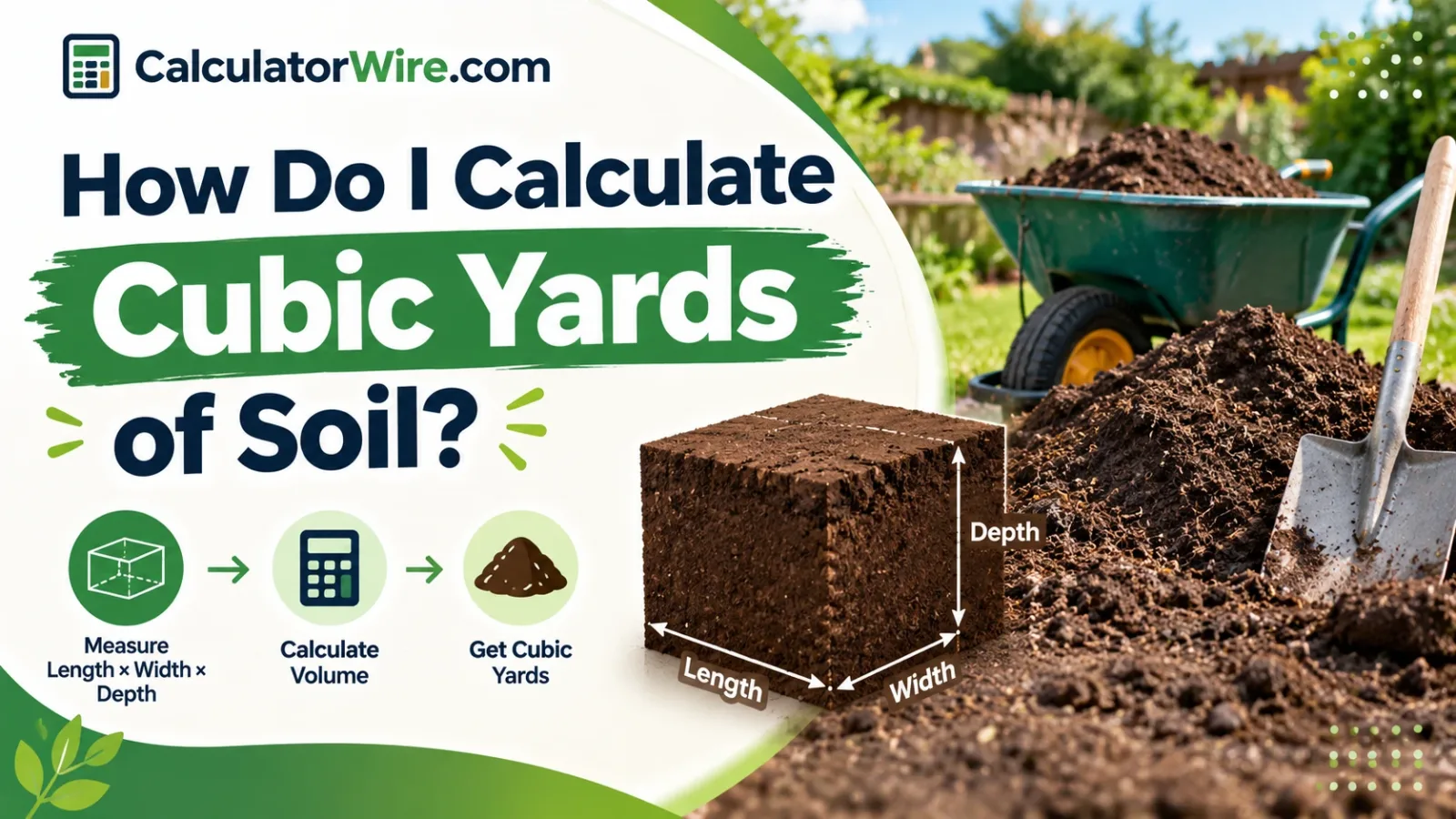
When buying soil for a garden bed, lawn, or a raised bed, there may be a lot of confusion as landscape suppliers sell soil in cubic yards, while we may measure our spaces in feet and inches. Ordering too little will cause you to wait until another delivery arrives, and ordering too much is just a waste of money. However, the good news is that there is no complicated math involved in finding the answer to this problem. This article provides an easy-to-follow guide for calculating cubic yards of soil.
Cubic Yard of Soil Definition
A cubic yard is simply a cube that is 3 feet long, 3 feet wide, and 3 feet high and therefore equals 27 cubic feet. This is the unit used by landscape suppliers to sell bulk soil, topsoil, compost, and mulch and, therefore, the number that you require when placing an order.
Basic Formula
As we can see, soil is a volume and we need three dimensions to measure it.
Cubic yards = Length (ft) × Width (ft) × Depth (ft) ÷ 27
However, in many cases, depth is measured in inches, which makes things a bit simpler as you can apply the following shortcut:
Cubic yards = Length (ft) × Width (ft) × Depth (in) ÷ 324
Note that 324 is equal to 27 multiplied by 12 and therefore allows you to avoid converting inches to feet.
Steps on How to Calculate Soil in Cubic Yards
Step 1: Measure the length and width. Use a tape measure and record the numbers in feet. If you measure in inches, divide by 12.
Step 2: Find the required depth. It varies depending on the particular task at hand. Here are some common depths:
- Lawn topdressing: 0.5 to 1 inch
- New lawn or seeding: 4 to 6 inches
- Flower beds: 6 to 12 inches
- Vegetable gardens and raised beds: 8 to 12 inches
Step 3: Multiply and divide. Choose one of the formulas provided above.
Step 4: Add the extra. As soil settles after spreading and as there is always a bit of loss, most people add about 5% to 10%.
Step 5: Round up. Suppliers sell soil by half or full yards, so round the answer to the nearest number.
Example 1: Rectangular Garden Bed
Your garden bed is 10 feet long and 12 feet wide and you need 3 inches of soil.
10 × 12 × 3 ÷ 324 = 1.11 cubic yards
With 10% extra, you end up with 1.2 cubic yards. Thus, order 1.25 cubic yards.
Example 2: Raised Bed
Your raised bed is 8 feet long, 4 feet wide and 12 inches deep (1 foot). Use the formula for the feet depth.
8 × 4 × 1 ÷ 27 = 1.19 cubic yards
With 10% extra, this becomes 1.3 cubic yards.
Example 3: Circular Area
To calculate cubic yards of soil in a round bed or tree ring, find the area first using this formula: π × radius × radius. Then multiply the area by depth.
Let’s say the radius of your circle is 4 feet and depth is 6 inches (0.5 feet).
3.14 × 4 × 4 = 50.27 square feet
50.27 × 0.5 = 25.13 cubic feet
25.13 ÷ 27 = 0.93 cubic yards
What to Do When the Area Is Not a Simple Shape?
In reality, your yard is unlikely to be a simple rectangle. What can you do then?
- Split the area into smaller rectangles, circles or triangles.
- Find cubic yards of soil for each part.
- Add the results together.
The area of a triangle is ½ × base × height. Then you can continue with the regular multiplication by the depth.
If the area is L-shaped, you can split it into two rectangles. If there is an object inside the area, for example, patio or tree trunk, measure it and deduct.
Quick Coverage Table
Here are the square feet of coverage for different depths for one cubic yard of soil:
- 1 inch deep: about 324 square feet
- 3 inches deep: about 108 square feet
- 6 inches deep: about 54 square feet
This table is useful if you need only a quick estimate and don’t want to go through the whole formula.
How Many Bags of Soil Equal a Cubic Yard?
Bags of soil are sold in cubic feet, but 1 cubic yard equals 27 cubic feet.
- 2 cubic foot bags: about 14 bags
- 1.5 cubic foot bags: about 18 bags
For small projects, it is acceptable to buy bagged soil. However, for bigger tasks, starting from half a cubic yard, it is more convenient to buy bulk soil, which is usually cheaper. Always compare prices per cubic foot.
How Much Does One Cubic Yard of Soil Weigh?
It is important when planning transportation. Usually, a cubic yard of topsoil weighs somewhere from 1 to 1.5 tons. Wet soil is heavier than dry soil and sandy soil is lighter than clay. You should ask your supplier about the weight of their products and make sure that your vehicle can carry this weight.
Metric Conversions
If you are measuring in meters, you need to calculate the volume in cubic meters first (length × width × depth in meters). Then multiply the result by 1.308 to get cubic yards.
Common Mistakes to Avoid:
- Mixing units. Do not multiply feet by inches. Make sure that all measurements are in the same units first.
- Forgetting the depth. Area is not sufficient in itself as soil is a volume.
- Neglecting extra. Soil settles and thus, you need to buy 5–10% extra.
- Ignoring compaction. If you are filling up the hole or low areas, the soil will settle even more.
- Not rounding up. Another delivery will cost you more than ordering a bit more initially.
Is it Worth Using a Soil Calculator?
Soil calculator or cubic yard calculator allows you to save time especially in case your project includes several areas. You simply enter the length, width and depth and receive the result in cubic yards, cubic feet and sometimes even bags. This tool is also good for checking your manual calculations. Nevertheless, knowing the formula allows you to identify mistakes beforehand.
Conclusion
To calculate cubic yards of soil, you need to measure the length, width and depth of your project, multiply these numbers and divide by 27 (or by 324 if depth is in inches). Don’t forget to add a small extra and round up. Once you know the formula, you can easily plan any project and order the exact amount of soil the first time.


0 Comments
Be the first to comment.
Leave a Comment